
RTI Blog / Training guides
How to track progressive overload
Log each working set, compare the same exercise and setup, and use reps and effort together to decide what comes next. Here is a practical reps-before-weight method you can use with a notebook, spreadsheet or app.
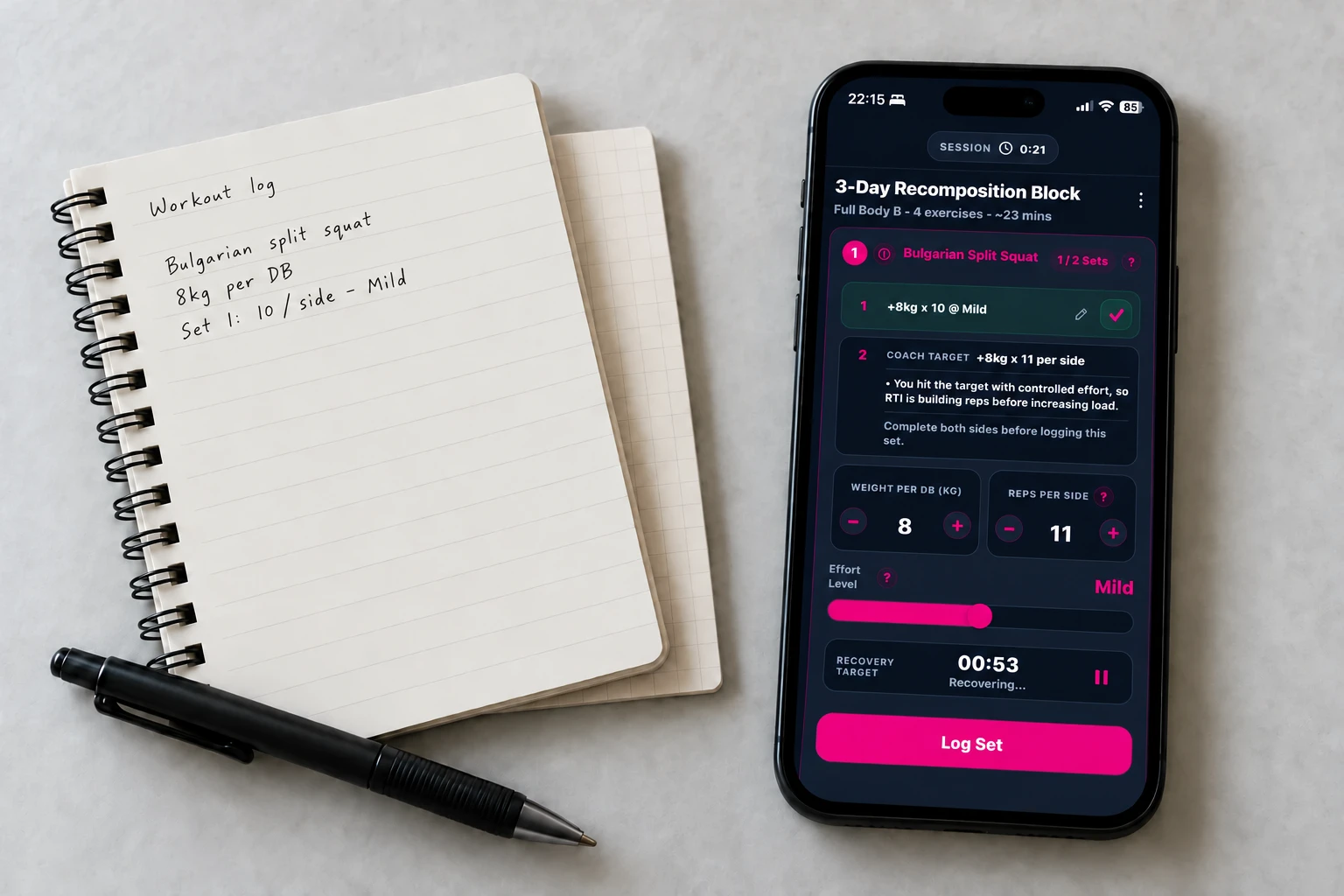
Training notes
The short version
- Log every working set: weight, completed reps and effort.
- Build reps at the same weight before taking a suitable load step.
- Keep the setup consistent and judge the trend across sessions.
What is progressive overload?
- progressive overloadnoun · resistance training
- The gradual increase in training demand as the body adapts, for example through more repetitions or a greater load.
It does not mean lifting more every workout. The 2026 American College of Sports Medicine (ACSM) position stand supports progressive resistance training while recognising that different approaches can work.
What to put in your workout log
- Exercise and setup: variation, machine settings, band or equipment, and whether loading is per dumbbell or total.
- Each working set: weight and reps actually completed. Keep warm-ups separate.
- Effort: how hard each set felt and whether technique or range of motion changed.
- Context: rest periods and relevant notes such as poor sleep, a different machine or an interrupted session.
Two 8 kg dumbbells are not 8 kg total. Different cable machines may not offer directly comparable resistance. Keep your convention consistent.
When should you add weight?
Double progression is one practical method: increase reps within a range, then increase load. For example, choose three working sets of 8–12 reps with an effort target appropriate to your programme.
- Keep the load while building reps within that range.
- When all three sets reach 12 with consistent technique, range of motion and the intended effort, consider a small load increase.
- After increasing, build from the lower end of the range again. If you cannot reach the lower end without exceeding your intended effort or losing technique, the jump is too large.
This is an example progression method, not a universal requirement or a description of RTI's exact algorithm. Other programmes progress individual sets or use different criteria. If you reach the top but the next weight is too heavy, use the top-of-range options below. Do not add weight just because the calendar says a week has passed.
Make effort ratings useful
RPE means Rating of Perceived Exertion. RTI simplifies it to effort out of 10. RIR means reps in reserve: an estimate of how many additional good reps you could complete. On the reps-in-reserve-based RPE scale, the following is a useful approximate guide:
- RPE 7
- About 3 reps left
- RPE 8
- About 2 reps left
- RPE 9
- About 1 rep left
- RPE 10
- No more good reps
The cited scale study tested novice and experienced squatters; it did not validate these fictional profiles or their exercises. Here the scale is an approximate logging guide, not an age-specific prescription. These estimates take practice, particularly for new lifters. Use them alongside completed reps and technique, rather than treating the number as exact. Reaching failure is not a prerequisite for every effective set; the American College of Sports Medicine (ACSM) review did not find a consistent advantage from training to momentary muscle fatigue.
Two people, two progression decisions

Clare, 55: building confidence and strength at home
Clare is new to resistance training and wants everyday strength and a routine she can sustain. In this example, she has learned a controlled goblet squat and uses one 8 kg dumbbell, held in both hands. That is 8 kg total external load, not 8 kg per hand.
Her example plan uses two working sets of 8–12 reps, stopping with about two or three good reps still possible. She builds reps at 8 kg, then uses an adjustable dumbbell to reach 8.5 kg instead of jumping straight to the next fixed 10 kg weight.
RTI / Worked example
Goblet squat
Illustrative example
Total completed reps by session
Total external load. Read rep totals alongside the weight used.
Session 1
2 / 2 working sets completed
- 18 kg × 10 reps✓
- 28 kg × 9 reps✓
Decision
Establish a controlled baseline at 8 kg.
Session 2
2 / 2 working sets completed
- 18 kg × 11 reps✓
- 28 kg × 10 reps✓
Decision
Add reps while keeping the same weight and technique.
Session 3
2 / 2 working sets completed
- 18 kg × 12 reps✓
- 28 kg × 12 reps✓
Decision
Reach the top of the range. Review technique, effort and the next load step.
Session 4
2 / 2 working sets completed
- 18.5 kg × 9 reps✓
- 28.5 kg × 8 reps✓
Decision
Use an adjustable dumbbell for a smaller increase. Start near the bottom of the rep range.
Session 5
2 / 2 working sets completed
- 18.5 kg × 10 reps✓
- 28.5 kg × 9 reps✓
Decision
Keep 8.5 kg and begin building reps again.

Why use 8.5 kg instead of 10 kg? The adjustable dumbbell makes a smaller step possible: 6.25% rather than 25%. It is still suitable only if Clare can maintain her intended effort, technique and rep range. After the increase, reps drop; session 5 shows them building again at the new weight.

Daniel, 30: building muscle with gym dumbbells
Daniel has lifting experience and is using an incline dumbbell press for muscle-building training, not testing maximal strength. His illustrative plan uses three working sets of 8–12 reps at about RPE 8, with a consistent bench angle, range of motion and rest. Load is recorded per dumbbell. His gym's next step after 20 kg is 22 kg.
RTI / Worked example
Incline dumbbell press
Illustrative example
Total completed reps by session
Load per dumbbell. Read rep totals alongside the weight used.
Session 1
3 / 3 working sets completed
- 120 kg × 10 reps✓
- 220 kg × 9 reps✓
- 320 kg × 8 reps✓
Decision
Establish a baseline at 20 kg per dumbbell.
Session 2
3 / 3 working sets completed
- 120 kg × 11 reps✓
- 220 kg × 10 reps✓
- 320 kg × 9 reps✓
Decision
Add reps with the same weight, technique and intended effort.
Session 3
3 / 3 working sets completed
- 120 kg × 12 reps✓
- 220 kg × 12 reps✓
- 320 kg × 12 reps✓
Decision
Reach the top of the range on all three sets. Consider the available load step.
Session 4
3 / 3 working sets completed
- 122 kg × 9 reps✓
- 222 kg × 8 reps✓
- 322 kg × 8 reps✓
Decision
Increase to 22 kg only because the reps, effort and technique remain suitable in this example.
Session 5
3 / 3 working sets completed
- 122 kg × 10 reps✓
- 222 kg × 9 reps✓
- 322 kg × 8 reps✓
Decision
Hold 22 kg and start building reps again.

The 22 kg step is 10%, not a universal recommendation. In this example it remains manageable. If Daniel instead managed only six controlled reps, or had to exceed his intended effort to reach eight, he would return to a suitable load or find a smaller increment rather than force the jump.
Session 4 starts a heavier-load baseline. Total reps and volume-load fall, which can happen when load increases. It does not by itself prove an equivalent or improved one-rep max. More comparable sessions are needed to judge the trend; the useful next task is building controlled reps at the new load.
What both examples show
Neither person has to beat the last session every time. Building reps at the same load, taking a manageable weight increase, and rebuilding reps can all belong in a progression plan. Record the decision as well as the numbers. The same person could need a different approach on a different exercise.
Stuck at the top of the range?
- If the next load is manageable, increase and rebuild reps within your chosen range.
- If the jump is too large, use a smaller compatible equipment increment or deliberately revise the rep range if that fits the plan. Record the new target range.
- If those options do not fit the goal or equipment, review the exercise or programme rather than adding reps or sets without a limit.
Pauses, tempo, additional sets and changes in range of motion can alter training demand too, but they are not interchangeable solutions. Record the changed task and establish a comparable baseline. Keep safe, consistent technique rather than treating a harder-looking number as the aim.
What to do when progress stalls
One weaker session is not enough to identify a plateau. Across several comparable sessions, check your logging convention, rest, effort and recovery before changing the programme. Review total weekly work as well as your best set, especially if you have been adding sets.
A planned lighter week, or deload, deliberately reduces training demand. Record the lighter work as planned rather than treating it as a failed progression test. A deload is one programming tool, not a mandatory response after a fixed number of stalled sessions. Persistent difficulty may need an individual programme review.
Tracking bodyweight and band exercises
For push-ups, record the variation, support height, reps and effort. For bands, record the band, anchor position and starting stretch. More controlled reps at the same setup can show progress. A harder variation or stronger band changes the baseline, so label it rather than pretending the numbers are directly equivalent.
Common tracking mistakes
- Comparing different machines, grips or range of motion without noting it.
- Logging only the best set and losing the rest of the workout.
- Counting extra reps gained by cutting the movement short as equivalent progress.
- Chasing volume-load as a universal workout-quality score.
- Expecting a personal best every session or training through pain.
Tracking it in RTI
RTI uses completed work and effort to guide subsequent coached targets, helping you decide what to do next. Depending on the workout and coaching settings, it can build reps, add load, hold steady or reduce work. The examples above explain tracking decisions, not one rule applied to every RTI workout.
Simple handles effort automatically, Guided offers broad effort choices, and Precision gives you numerical RPE control when recording sets. See the coaching controls.
Free includes logging within eligible coached workouts. Rep Logger is paid, available from Coach. It records self-directed sessions without a Session Score. Workout-building and reusable-template tools are also paid. Completed work from both approaches appears in training history.
Sources and scope
Written by RTI for healthy adults tracking resistance training. This is general education, not an individual programme or medical advice. Stop an exercise that causes pain and seek appropriate advice. If you have an injury or health condition, consult a qualified professional before changing training.
- Currier BS, D'Souza AC, Fiatarone Singh MA, et al. American College of Sports Medicine Position Stand. Resistance Training Prescription for Muscle Function, Hypertrophy, and Physical Performance in Healthy Adults: An Overview of Reviews. Medicine & Science in Sports & Exercise. 2026;58(4):851–872. DOI: 10.1249/MSS.0000000000003897.
- Zourdos MC, Klemp A, Dolan C, et al. Novel Resistance Training-Specific Rating of Perceived Exertion Scale Measuring Repetitions in Reserve. Journal of Strength and Conditioning Research. 2016;30(1):267–275. DOI: 10.1519/JSC.0000000000001049.
The progression methods and fictional logs are illustrative, not a study result or RTI's scoring logic. Product access is described on Pricing and Product facts.